


Page 5 - Length
P. 5
A millimetre (mm) is one of                     1 000 mm = 1 m
                  the parts that is formed when
                  1 m is divided into 1 000 equal
                  parts.

                  There are 1 000 mm in 1 m.
                  Milli- in millimetre means
                  thousandth.
                  There are 10 mm in 1 cm.                        10 mm = 1 cm

                  A kilometre (km) is 1 000                       1 000 m = 1 km
                  times as long as 1 m.
                  Kilo- in kilometre means
                  thousand.


               2. Which of the units will you use if you have to measure the
                   length of each of these objects?
                   (a) the length of your textbook

                   (b) the length of the classroom
                   (c) the thickness of your pencil

                   (d) the distance between two towns


                Most rulers have centimetres (cm) and millimetres (mm) as their
                units. We use rulers to measure shorter lengths such as the length
                of a book or the length in a geometric figure.

                  On measuring tapes you will see millimetres, centimetres
                and metres (m). We use measuring tapes to measure longer
                lengths, such as the height of a person or the length of a skirt. For
                even longer distances, such as the length of a wall in a building,
                there are builder’s tape measures and surveyor’s tape measures.
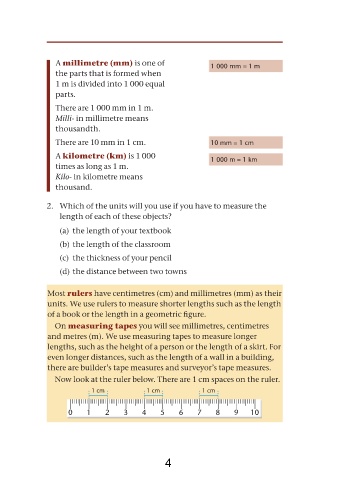
                  Now look at the ruler below. There are 1 cm spaces on the ruler.
                             1 cm             1 cm             1 cm


                      0     1    2     3     4    5     6     7    8     9    10


                                                    4

