


Page 29 - Whole Numbers (Addition and Subtraction)
P. 29
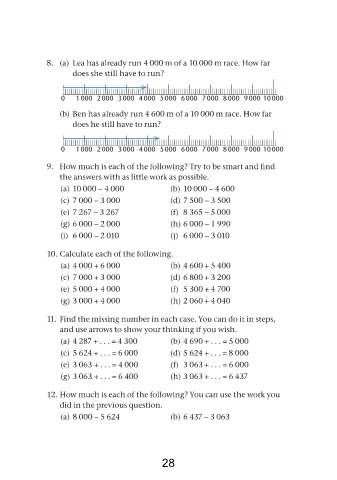
8. (a)  Lea has already run 4 000 m of a 10 000 m race. How far
                       does she still have to run?


                    0   1 000 2 000 3 000 4 000 5 000 6 000 7 000 8 000 9 000 10 000

                   (b) Ben has already run 4 600 m of a 10 000 m race. How far
                       does he still have to run?


                    0   1 000 2 000 3 000 4 000 5 000 6 000 7 000 8 000 9 000 10 000

               9. How much is each of the following? Try to be smart and find
                   the answers with as little work as possible.
                    (a) 10 000 − 4 000               (b) 10 000 − 4 600

                    (c) 7 000 − 3 000                (d) 7 500 − 3 500
                    (e) 7 267 − 3 267                (f) 8 365 − 5 000
                    (g) 6 000 − 2 000                (h) 6 000 − 1 990
                    (i) 6 000 − 2 010                (j) 6 000 − 3 010


               10. Calculate each of the following.
                    (a) 4 000 + 6 000                (b) 4 600 + 5 400
                    (c) 7 000 + 3 000                (d) 6 800 + 3 200
                    (e) 5 000 + 4 000                (f) 5 300 + 4 700

                    (g) 3 000 + 4 000                (h) 2 060 + 4 040

               11. Find the missing number in each case. You can do it in steps,
                   and use arrows to show your thinking if you wish.
                    (a) 4 287 + . . . = 4 300        (b) 4 690 + . . . = 5 000

                    (c) 5 624 + . . . = 6 000        (d) 5 624 + . . . = 8 000
                    (e) 3 063 + . . . = 4 000        (f) 3 063 + . . . = 6 000
                    (g) 3 063 + . . . = 6 400        (h) 3 063 + . . . = 6 437


               12. How much is each of the following? You can use the work you
                   did in the previous question.
                    (a) 8 000 − 5 624                (b) 6 437 − 3 063


                                                   28

