


Page 13 - Whole Numbers (Addition and Subtraction)
P. 13
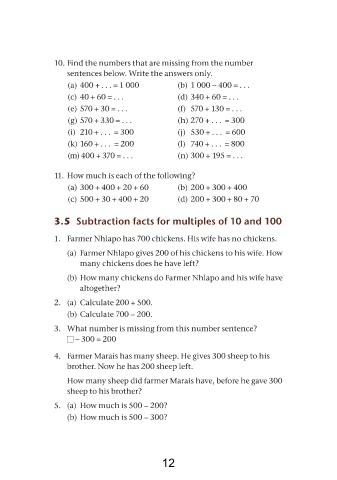
10. Find the numbers that are missing from the number
                      sentences below. Write the answers only.
                      (a) 400 + . . . = 1 000           (b) 1 000 − 400 = . . .

                      (c) 40 + 60 = . . .               (d) 340 + 60 = . . .
                      (e) 570 + 30 = . . .              (f) 570 + 130 = . . .
                      (g) 570 + 330 = . . .             (h) 270 + . . .  = 300
                      (i) 210 + . . .  = 300            (j) 530 + . . .  = 600

                      (k) 160 + . . .  = 200            (l) 740 + . . .  = 800
                      (m) 400 + 370 = . . .             (n) 300 + 195 = . . .


                  11. How much is each of the following?
                      (a) 300 + 400 + 20 + 60           (b) 200 + 300 + 400
                      (c) 500 + 30 + 400 + 20           (d) 200 + 300 + 80 + 70


                  3.5  Subtraction facts for multiples of 10 and 100


                  1. Farmer Nhlapo has 700 chickens. His wife has no chickens.

                      (a) Farmer Nhlapo gives 200 of his chickens to his wife. How
                          many chickens does he have left?
                      (b) How many chickens do Farmer Nhlapo and his wife have
                          altogether?

                  2. (a)  Calculate 200 + 500.
                      (b) Calculate 700 − 200.

                  3. What number is missing from this number sentence?
                        − 300 = 200

                  4. Farmer Marais has many sheep. He gives 300 sheep to his
                      brother. Now he has 200 sheep left.

                      How many sheep did farmer Marais have, before he gave 300
                      sheep to his brother?

                  5. (a)  How much is 500 − 200?
                      (b) How much is 500 − 300?


                                                   12

