


Page 14 - Whole Numbers (Addition and Subtraction)
P. 14
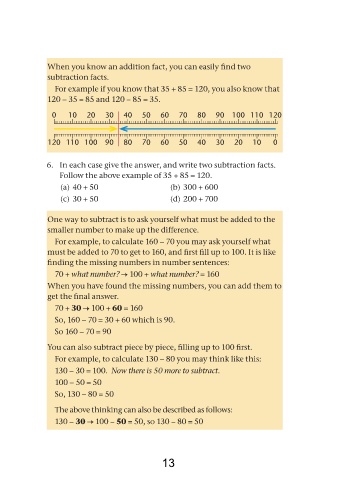
When you know an addition fact, you can easily find two
                subtraction facts.
                  For example if you know that 35 + 85 = 120, you also know that
                120 − 35 = 85 and 120 − 85 = 35.

                 0    10    20   30    40    50   60    70    80   90   100 110 120


                120 110 100      90    80    70   60    50    40   30    20    10    0


               6. In each case give the answer, and write two subtraction facts.
                   Follow the above example of 35 + 85 = 120.
                    (a) 40 + 50                      (b) 300 + 600
                    (c) 30 + 50                      (d) 200 + 700


                One way to subtract is to ask yourself what must be added to the
                smaller number to make up the difference.
                  For example, to calculate 160 − 70 you may ask yourself what
                must be added to 70 to get to 160, and first fill up to 100. It is like
                finding the missing numbers in number sentences:

                  70 + what number? → 100 + what number? = 160
                When you have found the missing numbers, you can add them to
                get the final answer.
                  70 + 30 → 100 + 60 = 160
                  So, 160 − 70 = 30 + 60 which is 90.

                  So 160 − 70 = 90

                You can also subtract piece by piece, filling up to 100 first.
                  For example, to calculate 130 − 80 you may think like this:
                  130 − 30 = 100.  Now there is 50 more to subtract.
                  100 − 50 = 50

                  So, 130 − 80 = 50

                  The above thinking can also be described as follows:
                  130 − 30 → 100 − 50 = 50, so 130 − 80 = 50


                                                   13

