


Page 11 - Whole Numbers (Addition and Subtraction)
P. 11
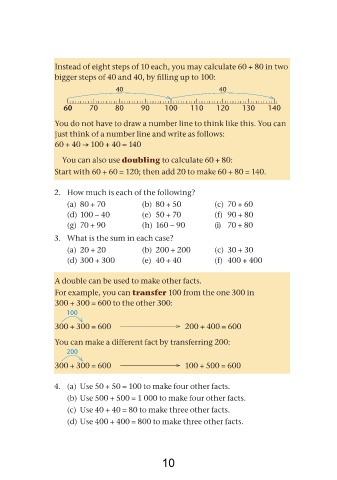
Instead of eight steps of 10 each, you may calculate 60 + 80 in two
                  bigger steps of 40 and 40, by filling up to 100:
                                     40                             40


                     60      70     80      90      100     110     120    130     140

                  You do not have to draw a number line to think like this. You can
                  just think of a number line and write as follows:
                  60 + 40 → 100 + 40 = 140

                    You can also use doubling to calculate 60 + 80:
                  Start with 60 + 60 = 120; then add 20 to make 60 + 80 = 140.


                  2. How much is each of the following?
                      (a) 80 + 70            (b) 80 + 50           (c) 70 + 60
                      (d) 100 − 40           (e) 50 + 70           (f) 90 + 80
                      (g) 70 + 90            (h) 160 − 90          (i) 70 + 80

                  3. What is the sum in each case?
                      (a) 20 + 20            (b) 200 + 200         (c) 30 + 30
                      (d) 300 + 300          (e) 40 + 40           (f) 400 + 400


                  A double can be used to make other facts.
                  For example, you can transfer 100 from the one 300 in
                  300 + 300 = 600 to the other 300:
                     100

                  300 + 300 = 600                             200 + 400 = 600

                  You can make a different fact by transferring 200:
                      200
                  300 + 300 = 600                             100 + 500 = 600


                  4. (a)  Use 50 + 50 = 100 to make four other facts.
                      (b) Use 500 + 500 = 1 000 to make four other facts.

                      (c) Use 40 + 40 = 80 to make three other facts.
                      (d) Use 400 + 400 = 800 to make three other facts.


                                                   10

