


Page 3 - Whole Numbers (Addition and Subtraction)
P. 3
5. How much is each of the following?
                      (a) 6 + 6        (b) 6 + 7        (c) 7 + 7        (d) 7 + 8
                      (e) 5 + 5        (f) 10 + 5       (g) 15 + 5       (h) 20 + 5
                      (i) 35 − 5       (j) 30 − 5       (k) 25 − 5       (l) 20 − 5
                      (m) 7 + 3        (n) 6 + 4        (o) 5 + 5        (p) 4 + 6
                      (q) 10 − 3       (r) 10 − 7       (s) 10 − 4       (t) 10 − 6
                      (u) 8 + 2        (v) 16 + 4       (w) 26 + 4       (x) 36 + 4


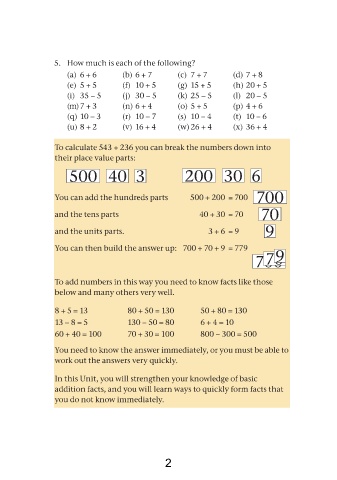
                  To calculate 543 + 236 you can break the numbers down into
                  their place value parts:

                      500 40 3                            200 30 6


                  You can add the hundreds parts            500 + 200  = 700    700

                  and the tens parts                          40 + 30  = 70      70

                  and the units parts.                           3 + 6  = 9        9


                  You can then build the answer up:  700 + 70 + 9  = 779
                                                                                      9
                                                                                   70
                                                                               700

                  To add numbers in this way you need to know facts like those
                  below and many others very well.


                  8 + 5 = 13            80 + 50 = 130          50 + 80 = 130
                  13 − 8 = 5            130 − 50 = 80          6 + 4 = 10
                  60 + 40 = 100         70 + 30 = 100          800 − 300 = 500

                  You need to know the answer immediately, or you must be able to
                  work out the answers very quickly.


                  In this Unit, you will strengthen your knowledge of basic
                  addition facts, and you will learn ways to quickly form facts that
                  you do not know immediately.


                                                    2

