


Page 4 - Whole Numbers (Addition and Subtraction)
P. 4
6. Copy and complete the number sentences. Do not count!
                    (a) 3 + 7 = . . .                (b) 3 + 8 = . . .
                    (c) 11 − 3 = . . .               (d) 11 − 8 = . . .

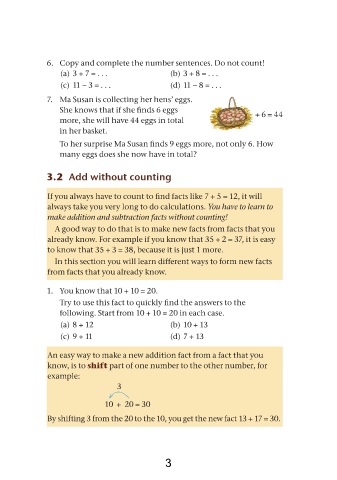
               7. Ma Susan is collecting her hens’ eggs.
                   She knows that if she finds 6 eggs                           + 6 = 44
                   more, she will have 44 eggs in total
                   in her basket.

                   To her surprise Ma Susan finds 9 eggs more, not only 6. How
                   many eggs does she now have in total?


               3.2  Add without counting


                If you always have to count to find facts like 7 + 5 = 12, it will
                always take you very long to do calculations. You have to learn to
                make addition and subtraction facts without counting!
                  A good way to do that is to make new facts from facts that you
                already know. For example if you know that 35 + 2 = 37, it is easy
                to know that 35 + 3 = 38, because it is just 1 more.
                  In this section you will learn different ways to form new facts
                from facts that you already know.


               1. You know that 10 + 10 = 20.
                   Try to use this fact to quickly find the answers to the
                   following. Start from 10 + 10 = 20 in each case.
                    (a) 8 + 12                       (b) 10 + 13

                    (c) 9 + 11                       (d) 7 + 13

                An easy way to make a new addition fact from a fact that you
                know, is to shift part of one number to the other number, for
                example:
                                     3


                                     10  +  20 = 30
                By shifting 3 from the 20 to the 10, you get the new fact 13 + 17 = 30.


                                                    3

