


Page 5 - Whole Numbers (Addition and Subtraction)
P. 5
2. (a)  Shift 5 from the one 20 to the other 20 to make a new fact
                          from 20 + 20 = 40.

                      (b) Shift 3 to make another fact from 20 + 20 = 40.

                      (c) Make three more facts from 20 + 20 = 40.
                  3. (a)  Make three different facts from 10 + 5 = 15.

                      (b) Make three different facts from 10 + 7 = 17.


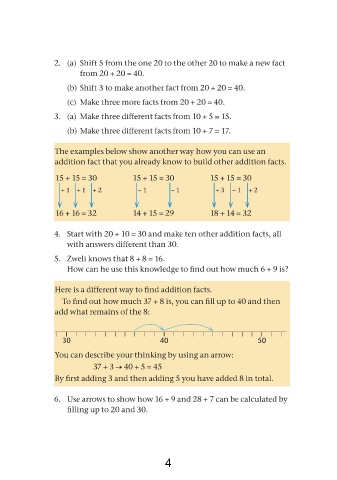
                  The examples below show another way how you can use an
                  addition fact that you already know to build other addition facts.

                  15 + 15 = 30            15 + 15 = 30            15 + 15 = 30

                    + 1  + 1  + 2          − 1        − 1          + 3   − 1   + 2


                  16 + 16 = 32            14 + 15 = 29            18 + 14 = 32


                  4. Start with 20 + 10 = 30 and make ten other addition facts, all
                      with answers different than 30.

                  5. Zweli knows that 8 + 8 = 16.
                      How can he use this knowledge to find out how much 6 + 9 is?


                  Here is a different way to find addition facts.
                    To find out how much 37 + 8 is, you can fill up to 40 and then
                  add what remains of the 8:


                    30                            40                            50

                  You can describe your thinking by using an arrow:
                             37 + 3 → 40 + 5 = 45

                  By first adding 3 and then adding 5 you have added 8 in total.


                  6. Use arrows to show how 16 + 9 and 28 + 7 can be calculated by
                      filling up to 20 and 30.


                                                    4

